

Every mutual fund factsheet throws a return number at you like it’s gospel truth. “This fund gave 18% returns!” Great. But 18% calculated how? Over which period? With what cash flow pattern?
Most investors never ask. That’s exactly why so many end up disappointed when their actual portfolio doesn’t match the “return” they thought they signed up for.
Let’s fix that today — with real numbers, not textbook theory.
1. CAGR — The One-Time Investment Story
CAGR (Compounded Annual Growth Rate) answers one simple question: “If I invested a lump sum once and let it sit, what annual growth rate got me from Point A to Point B?”
Example: You invest ₹1,00,000 in a mutual fund. Five years later, it’s worth ₹1,76,234.
CAGR = (End Value / Start Value)^(1/n) − 1 = (1,76,234 / 1,00,000)^(1/5) − 1 = 12%
Clean. Simple. But here’s the catch — CAGR assumes ONE cash flow, at ONE point in time. It has no idea what to do if you added money in year 2, withdrew some in year 4, or started a SIP. Ask CAGR to handle multiple transactions and it just breaks down.
2. XIRR — The Real-Life Investor’s Number
Nobody invests in one shot and forgets about it. You do SIPs, top-ups, occasional withdrawals — money moves in and out on different dates. This is where XIRR (Extended Internal Rate of Return) steps in.
Example: You did this:
- ₹10,000 on 1 Jan 2023
- ₹10,000 on 1 Jul 2023
- ₹10,000 on 1 Jan 2024
- Portfolio value on 1 Jan 2025 = ₹36,500
Plug these into Excel’s XIRR formula (dates + cash flows), and you’ll get something like 14.2%.
Notice — you invested ₹30,000 in total and got ₹36,500. A naive investor might calculate simple return as (36,500-30,000)/30,000 = 21.7% and feel great. But XIRR accounts for when each rupee was invested — money put in earlier had more time to grow, so it’s weighted differently. That 14.2% is the honest, time-adjusted answer.
Rule of thumb: SIP investor? Always ask for XIRR, never CAGR. A fund’s “CAGR since inception” tells you nothing about what YOUR staggered investments actually earned.
3. Rolling Returns — The Consistency Detector
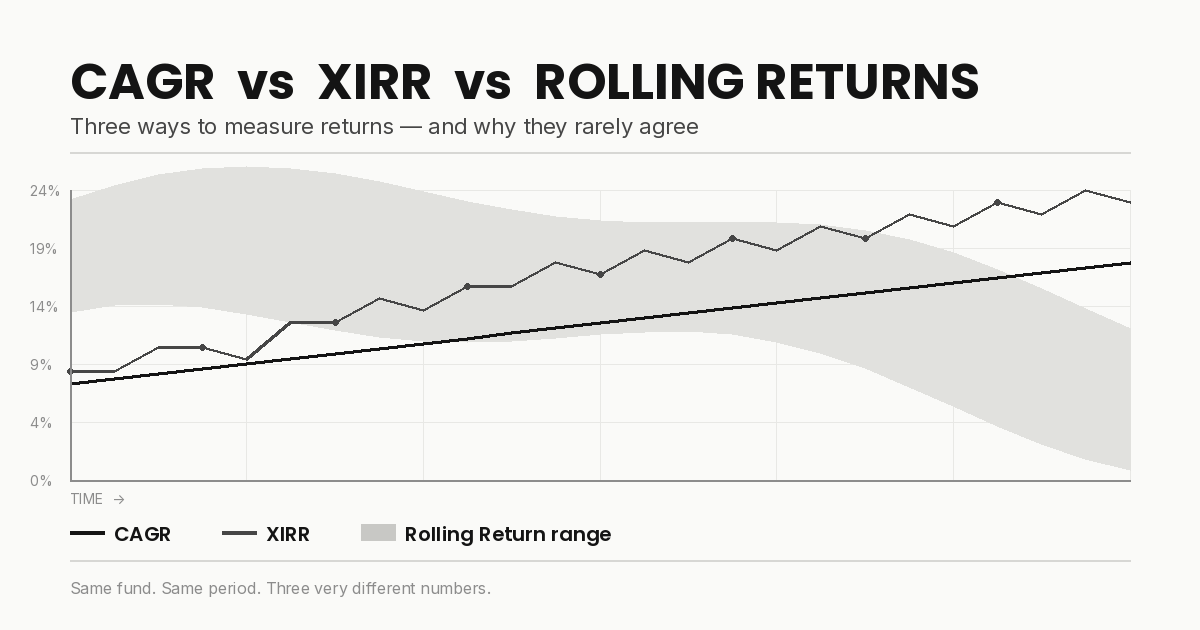
Here’s the sneaky part both CAGR and XIRR hide: they only tell you about ONE specific start and end date. Change the dates slightly, and the story can flip completely.
This is where Rolling Returns come in. Instead of one CAGR calculation, you calculate CAGR for every possible 3-year (or 5-year) window in the fund’s history and then look at the average, best, worst, and consistency.
Example: A fund existed from 2015 to 2025. Instead of just checking “2015 to 2025 CAGR,” you check:
- 2015–2018 CAGR
- 2016–2019 CAGR
- 2017–2020 CAGR
- …and so on, rolling forward month by month.
Suppose the results range from 4% (worst 3-year window) to 22% (best 3-year window), averaging 13%. Now compare this to a second fund whose point-to-point CAGR also shows 13%, but its rolling returns range from 11% to 15%.
Same headline CAGR. Completely different risk profile. Fund 2 is far more dependable — you don’t want a fund where your outcome depends heavily on which exact month you entered.
The Side-by-Side Reality Check
| Metric | Best used for | What it ignores |
|---|---|---|
| CAGR | One-time lump sum investment | Multiple cash flows, timing |
| XIRR | SIPs, top-ups, withdrawals | Consistency across different periods |
| Rolling Return | Judging consistency & entry-timing risk | Your actual personal cash flow |
None of the three is “the best” — they answer different questions. A smart investor uses XIRR to know their own actual earnings, and rolling returns to judge whether a fund is reliable before investing.
The One Line to Remember
CAGR tells you the story of money that sat still. XIRR tells you the story of your money. Rolling returns tell you whether that story repeats itself — or was just a lucky year.
Next time a fund pitch throws a shiny return number at you, ask: “Is this CAGR, XIRR, or rolling return — and over which period?” That one question separates informed investors from everyone else.
Disclaimer: Mutual fund investments are subject to market risks. This article is for educational purposes and does not constitute investment advice.


Leave a Reply